The world of coding is changing faster than ever. Just a few years ago, writing code meant sitting in front of an IDE, typing complex logic line by line. But today, tools like ChatGPT, GitHub Copilot, Amazon CodeWhisperer, and Replit Ghostwriter are reshaping how we think about software creation.
Welcome to Vibe Coding — also known as AI-led or prompt-based coding.
In this new paradigm, the developer’s role is shifting from writing code to orchestrating it — from syntax and loops to creativity, clarity, and intent. You no longer have to focus on “how” to build it; you focus on “what” you want to build.
What is Vibe Coding?
Vibe Coding refers to the practice of writing code using natural language prompts, where an AI engine interprets your intent and generates the underlying code automatically.
It’s called “Vibe” because the developer doesn’t necessarily know (or even see) every line of code — they rely on the vibe or intent of the prompt and trust the AI to get it right.
For example:
Instead of writing a React component manually, you might say:
“Create a responsive login page with email, password fields, validation, and a login API call.”
And in seconds, the AI generates everything — HTML, CSS, and JS — ready to deploy.
That’s Vibe Coding in action.

How Vibe Coding Works
The process of Vibe Coding relies on Generative AI models (like GPT-5, Claude, Gemini, etc.) that have been trained on vast amounts of code, documentation, and programming patterns.
Here’s how it typically works:
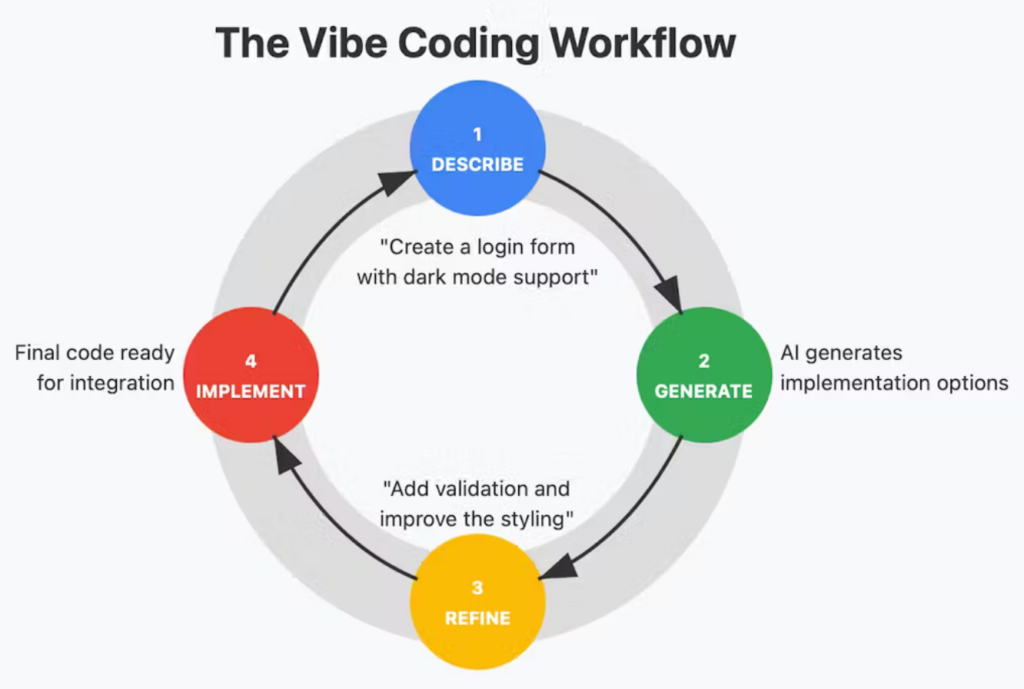
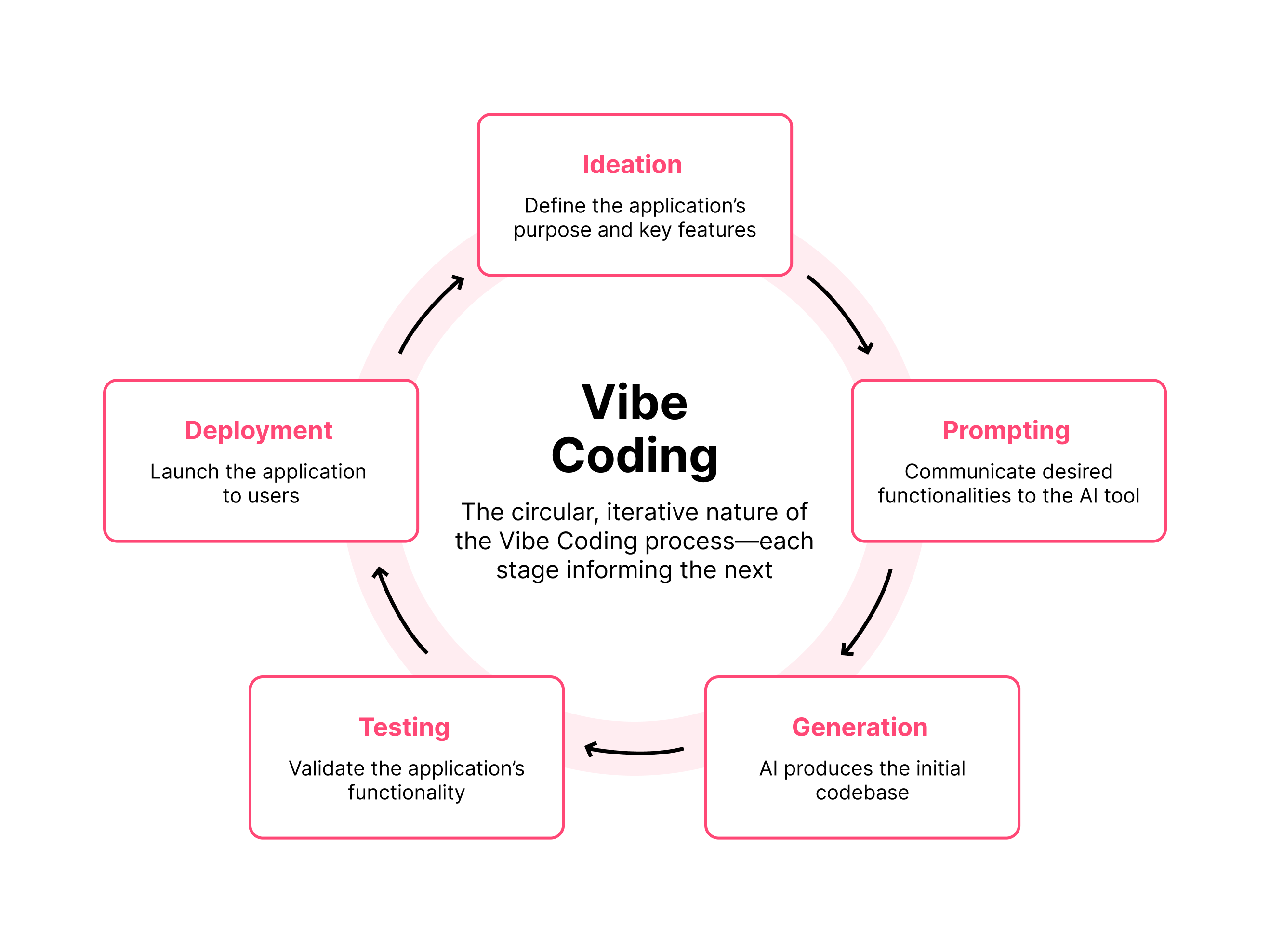
- Prompt Creation: The developer writes a clear prompt describing the desired functionality.
Example: “Build a REST API in Python for managing student records with CRUD operations.” - AI Interpretation: The AI model analyzes the request, breaks it down into logical components, and generates relevant code structures.
- Code Generation: The AI writes complete scripts, classes, or even multi-file projects.
- Review & Refinement: The developer reviews, tests, and modifies the generated output as needed.
- Continuous Feedback Loop: The system learns from user feedback and evolves with better contextual understanding over time.
Essentially, Vibe Coding = Prompt → Code → Review → Refine → Deploy
Why “Vibe Coding” is Trending in 2025
Vibe Coding has exploded in popularity because it simplifies one of the most complex human activities — software creation. Here’s why developers and organizations are adopting it fast:
1. Speed & Productivity
A task that took 4 hours can now take 4 minutes.
Developers focus on logic and design rather than syntax.
2. Accessibility
Non-coders can now participate in the development process. Business analysts, designers, or educators can describe what they need and get working prototypes.
3. Creativity Unlocked
AI takes care of boilerplate and repetitive code, freeing developers to focus on innovation and UX.
4. Cost Efficiency
Startups save time and cost by reducing the man-hours required for development.
5. AI as a Coding Partner
Vibe Coding introduces a new kind of collaboration — human + machine. The AI isn’t replacing developers; it’s amplifying them.
Vibe Coding vs. Traditional Coding
| Aspect | Traditional Coding | Vibe Coding (AI-led) |
|---|---|---|
| Approach | Developer writes syntax and logic manually | Developer writes natural language prompts |
| Focus | Code correctness & algorithms | Functional intent & outcome |
| Skillset | Technical syntax knowledge | Prompting, logic design, creativity |
| Speed | Slower, requires manual work | Very fast, near-instant code generation |
| Tools | IDEs like VS Code, PyCharm | AI tools like ChatGPT, Copilot, Replit |
| Debugging | Manual testing | AI-assisted correction |
| Learning Curve | Steep for beginners | Easier for newcomers |
Vibe Coding doesn’t replace traditional coding; it augments it. The best developers combine both approaches.
Tools Powering Vibe Coding in 2025
- ChatGPT (OpenAI GPT-5)
Can generate entire apps, websites, or scripts from plain English prompts. - GitHub Copilot X
Integrates into IDEs, suggesting and autocompleting code with deep context. - Amazon CodeWhisperer
Enterprise-level AI coding assistant that supports AWS integrations. - Replit Ghostwriter
Great for full-stack prototyping — builds, runs, and debugs code instantly. - Cursor IDE / Cody by Sourcegraph
Context-aware tools that understand entire codebases and modify them on command. - Tabnine / Codeium
Privacy-focused AI code completion tools for businesses and developers.
The Role of Prompts in Vibe Coding
In Vibe Coding, prompts are the new syntax.
The way you structure and phrase your prompt determines how well the AI understands your intent.
Example of a weak prompt:
“Make a login page.”
Example of a strong prompt:
“Create a responsive login page in React with a modern UI, email and password validation, a Remember Me option, and integration with Firebase authentication.”
Prompt engineering has become a core skill for modern developers — the clearer your request, the better the result.
The Benefits of Vibe Coding
1. Faster Development
Accelerates prototyping and product iteration.
2. Reduces Human Error
AI auto-completes common patterns and eliminates repetitive syntax errors.
3. Bridges Skill Gaps
Newcomers or non-tech founders can participate in early-stage development.
4. Enhances Collaboration
Teams can communicate intent directly in natural language.
5. Continuous Learning
AI models learn from user feedback, improving results over time.
Challenges & Risks of Vibe Coding
While it’s revolutionary, Vibe Coding also comes with its share of challenges:
1. Over-reliance on AI
Developers may become too dependent on AI, losing touch with core fundamentals.
2. Code Quality & Security
Generated code might contain hidden vulnerabilities, inefficient logic, or licensing issues.
3. Debugging Difficulty
When AI writes thousands of lines you didn’t author, debugging becomes complex.
4. Lack of Transparency
Developers may not fully understand how or why the AI produced a specific solution.
5. Ethical Concerns
AI models trained on public repositories might reuse copyrighted code unintentionally.
Solution? Combine human oversight with AI generation — trust, but verify.
The Future of Vibe Coding
Vibe Coding is just the beginning. In the near future, we’ll see:
1. Fully Conversational Development Environments
You’ll chat with your IDE like a teammate:
“Add a payment gateway to this checkout flow.”
“Optimize this API for speed.”
2. AI Agents as Co-Developers
Autonomous AI agents that build, test, and deploy entire micro-apps with minimal input.
3. Integration with Voice and Vision
Voice-based coding (“Alexa, build me a portfolio site”) or visual prompting (drawing an interface that AI converts into code).
4. Adaptive Learning Models
AI that learns your coding style, framework preferences, and business logic patterns.
5. Ethical & Responsible AI Standards
Developers will demand transparency and explainability in AI-generated code.
Impact on Developers
- Beginners: Easier entry point into coding; focus on logic and creativity.
- Professionals: Shift from typing code to architecting systems and managing AI workflows.
- Educators: Teach prompt-based problem solving instead of just syntax.
- Businesses: Faster product development, reduced costs, and scalable code delivery.
Vibe Coding in the Real World
Many startups and enterprises are already adopting this paradigm:
- Startups are building MVPs using AI in days, not months.
- Developers use AI to generate boilerplate and focus on innovation.
- Companies integrate AI in their CI/CD pipelines to auto-review and optimize code.
It’s not science fiction — it’s happening now.
FAQs
Q1: What exactly does “Vibe Coding” mean?
It’s the practice of writing software using natural language prompts instead of traditional code. AI interprets your intent and generates the code automatically.
Q2: Is Vibe Coding suitable for beginners?
Yes! Beginners can describe what they want to build and learn coding concepts by reviewing AI-generated outputs.
Q3: Can Vibe Coding replace developers?
No. AI can write code, but it can’t replace human logic, creativity, or business understanding. Developers will act as AI directors, not just coders.
Q4: Which languages work best for Vibe Coding?
Languages with strong AI support like Python, JavaScript, and TypeScript currently lead the way.
Q5: What’s the future of Vibe Coding?
It’s evolving into full AI-powered software design, where humans provide vision and AI handles implementation.
Conclusion
Vibe Coding is not the end of programming — it’s the evolution of it.
The future belongs to developers who understand how to communicate with AI, not just how to type code.
As AI coding assistants mature, coding will feel less like engineering and more like creative direction. You’ll describe your ideas, and the system will bring them to life.
Whether you’re a student, startup founder, or seasoned developer, now is the time to learn prompt-based development — because the next generation of coders won’t just code; they’ll vibe with AI.